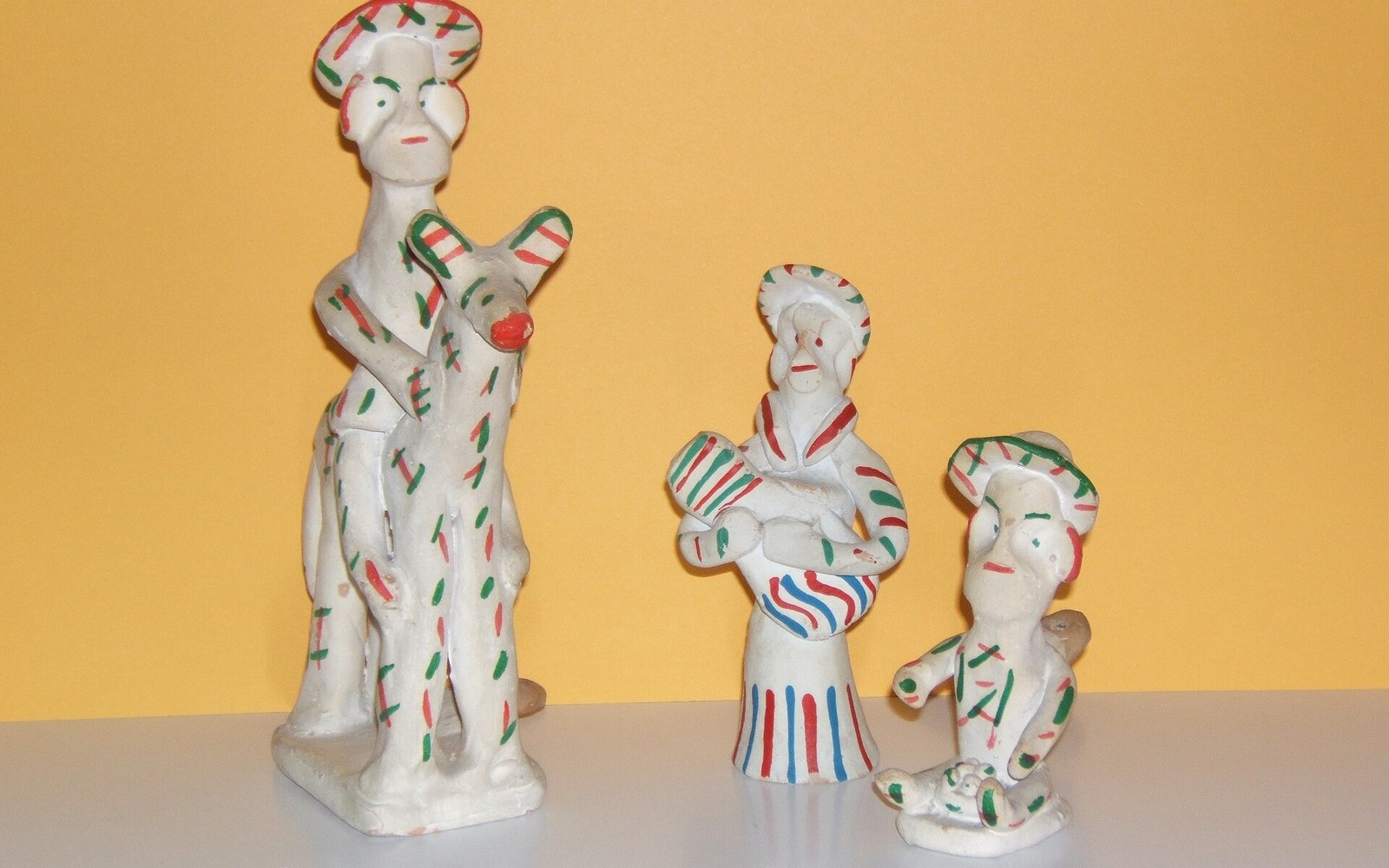
A small clay figure, whitewashed and marked in green or red, that has been made on this island since before anyone thought to sell it to a visitor.
What a siurell is
The siurell (roughly SYOO-rell) is a hollow clay figurine with a whistle built into its base. Most stand no taller than a hand's width. The form is almost always one of a small cast: a man on horseback, a musician, a bull, occasionally a figure with a donkey. Each one is fired, dipped in white slip, then decorated with strokes of green — sometimes red — painted freehand and left deliberately rough. The whistle works. That is not incidental; it is the point.
The figures almost certainly predate the tourist economy that now buys most of them. Scholars have traced whistling clay figurines in the Balearic Islands to very early periods ↗, with some suggesting Moorish or even Phoenician roots, though the evidence thins the further back you push it. What is clear is that they were made on the island long before the twentieth century, and that the whitewash-and-green palette is specific to Mallorca — not borrowed, not imported, not adapted from mainland Spanish folk ceramics.
Production today is concentrated in a few workshops, most of them in the Raiguer and Pla zones of central Mallorca — Sa Cabaneta, near Marratxí, is the village most associated with the trade. The method is hand-modelling, not mould-casting for the traditional pieces, though cheaper versions made for the souvenir market are press-moulded. A trained eye distinguishes them immediately: the hand-made figure carries small asymmetries that the mould cannot replicate, and the painted marks have weight and speed behind them.
The siurell sits in a broader Mallorcan tradition of worked clay, alongside roof tiles and storage vessels that the island's workshops produced for centuries. It has ended up on design posters and in museum collections — the Museu de Mallorca in Palma holds documented examples — partly because its form is so compressed and so entirely local that it resists imitation without looking like a copy of something else.