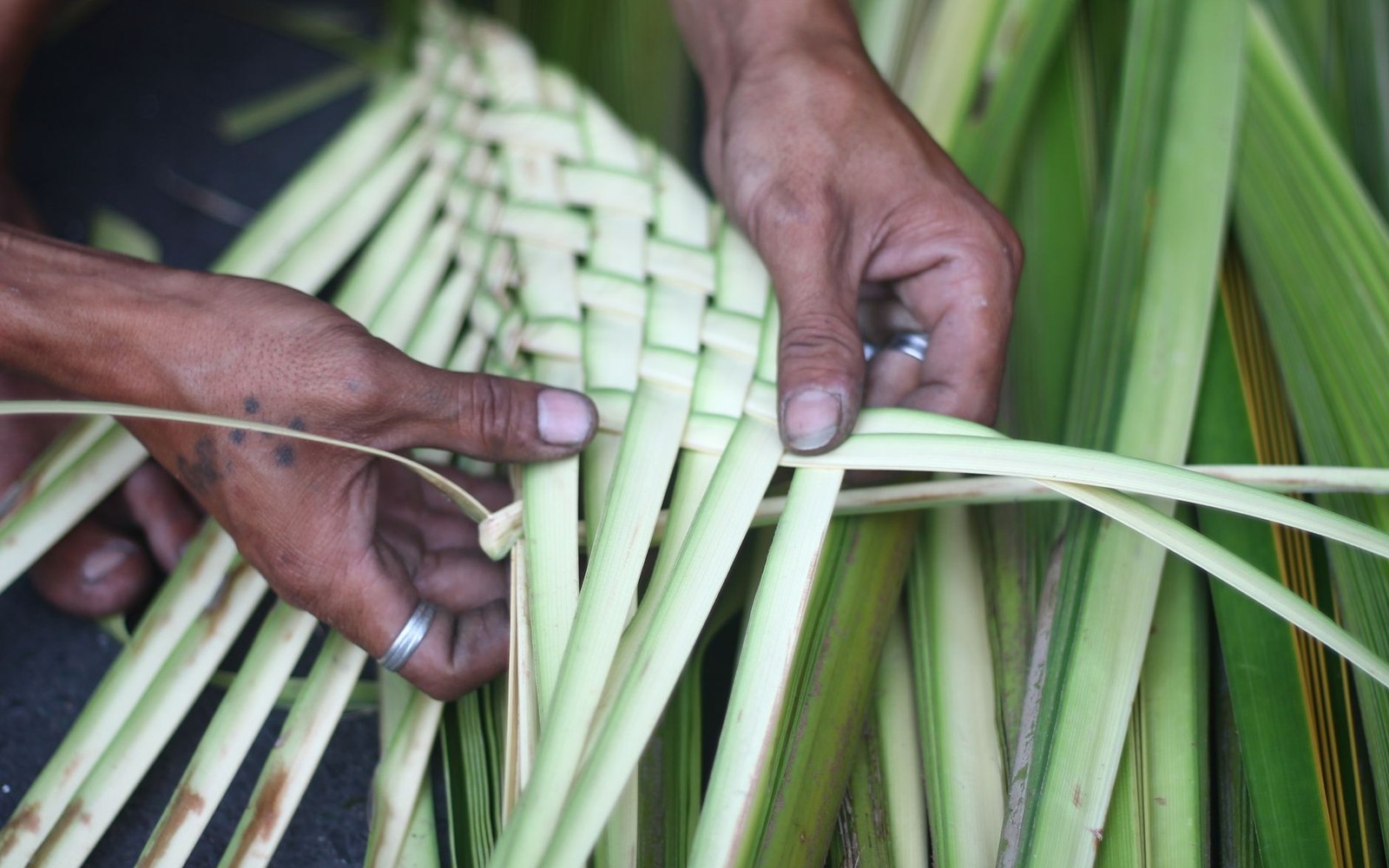
Artà's llata basketry uses dwarf-palm leaf and is the town's oldest documented trade, worked at home rather than in workshops.
The plant that made the trade
The dwarf palm, Chamaerops humilis, is the only palm native to Europe, and on the limestone hills around Artà it grows without encouragement — in the garrigue scrub of the Llevant, in the rocky margins of dry-stone terraces, along the sunburned flanks of the hills below Sant Salvador. For most plants that widespread, presence is simply a fact of the landscape. For the people who have lived here across several centuries, the dwarf palm was raw material.
The craft built from it is called llata — strictly, llata is the plaited strip itself, the long flat braid of dried palm leaf that a worker produces before shaping begins, and by extension the name has come to cover the whole tradition of plaited goods the town produces. Hats, baskets, bags, table mats, panniers, market carriers: the range was always domestic and agricultural before it was decorative. The tourist market arrived late; the craft predates it by centuries.
Artà holds the oldest documented evidence of commercial llata production in Mallorca. Municipal and guild records place organised basket-making in the town well back into the early modern period, and it is consistently described as home-based work — carried out in kitchens and courtyards rather than in workshops, fitted around farming and household rhythms, practised by women as the primary economic activity of a household's slower months. The scholar Miquel Fuster Aguiló documented Artà's pre-eminence in the trade in the twentieth century, and subsequent research in the Arxiu Municipal d'Artà has confirmed the town's role as the centre of the island's llata output, with finished pieces — and the braided strip itself — travelling to markets elsewhere on the island.
Leaf to braid: how the work is done
The raw material is the young, still-folded frond of Chamaerops humilis, cut before it opens fully. Left to mature, the leaf fans wide and becomes too coarse to plait; the craft depends on catching it at the moment when the fibres are supple but already strong. Cut fronds are dried in shade — direct sun bleaches them too fast and makes them brittle — and then dampened slightly before work begins, so the leaf regains just enough flexibility to accept the tight folding a good braid requires.
A llata strip is typically between two and four centimetres wide. A practised worker builds the braid continuously, adding leaf as each strand runs short, keeping the tension even throughout. The strip accumulates in a coil. When there is enough — and the length required depends entirely on the object being made — the plaited strip is stitched or bound into shape: wound in a rising spiral for a basket, shaped over a form for a hat, laid flat and joined for a mat. The needle follows the edge of each round of braid as the strip is stitched by hand.
The knowledge is in the hands and the eye, not in specialised equipment.
The tools required are minimal: a knife for cutting, a bodkin or large needle for stitching, thread strong enough to hold under the stress of a loaded basket. Some workers use a wooden form to shape hats; much of the rest is done freehand, with shape maintained by the tension of the stitching. The knowledge is in the hands and the eye, not in specialised equipment.
Home-based, always
What distinguishes Artà's llata tradition from the occasional craft-fair production found elsewhere on the island is its character as genuine household work — economic activity that sustained families rather than hobby production that supplemented them. The palm grew locally and cost nothing to gather; the tools were cheap; the skills passed between generations within households rather than through formal apprenticeship. A daughter learned to plait by watching and doing, the way one learns a language, without a curriculum.
This structure shaped the trade's economics. Because the capital costs were negligible and the work fitted around other obligations, llata production absorbed labour that would otherwise have had no market. The finished pieces were sold at weekly markets — at the mercat of Artà itself, and carried to the larger markets of other towns — or collected by intermediaries who resold them across the island. The household retained control of its own production pace; the intermediary took the margin. This arrangement was common enough in pre-industrial rural crafts across the Mediterranean, and in Artà it persisted well into the twentieth century.
Industrialisation did not destroy the craft so much as reclassify it. Machine-woven palm goods from North Africa and Southeast Asia undercut the everyday market — the utilitarian basket that had once been made locally for a few pesetas could now be imported for less. What survived in Artà was the upper tier: finer workmanship, recognisable local design, goods bought by people who wanted the object and knew what they were buying. The quality of the braid — the evenness of the plait, the tightness of the stitching, the consistency of the drying — became the distinguishing feature rather than the price.
What survives and what doesn't
Today the craft survives in Artà rather than thriving. A small number of families continue to work palm, and the finished goods appear in the town's weekly market and in a handful of local shops. The Museu Regional d'Artà holds examples of traditional llata work in its collection, placing the craft in context alongside the town's other documented traditions. Chamaerops humilis ↗ is not endangered — the plant is widespread around the western Mediterranean — but skilled workers who know how to take the frond at the right moment, dry it correctly, and plait at the tension the craft demands are genuinely fewer than they were.
The wider Mallorcan craft economy shows the same pattern. The Serra de Tramuntana's dry-stone terracing carries a UNESCO cultural landscape listing that has brought attention and some funding to the maintenance of traditional skills; llata basketry carries no equivalent formal recognition at European level, though it appears on regional inventories of intangible cultural heritage maintained by the Consell de Mallorca. Recognition of that kind rarely pays a wage, but it does provide a framework for documentation — for recording techniques, mapping remaining practitioners, and preserving the knowledge even when the market is thin.
Key
- Mallorca
- Mediterranean
- This piece
- ●Artà · Coves d'Artà — the town itself, and the caves in the cliff east of it
What the trade has never lost is its relationship to the landscape around it. The dwarf palm on the hillsides above Artà is the same plant it always was, growing in the same places, cut in the same season. A basket made here begins outside the town before it begins inside a house. That continuity — plant to hand to object — is rarer than it sounds, and it is the thing that makes Artà's llata tradition worth understanding rather than simply admiring. The craft is not a performance of the past; it is a slow-moving present, shaped by the same hills and the same material that shaped it when the oldest guild records were written.