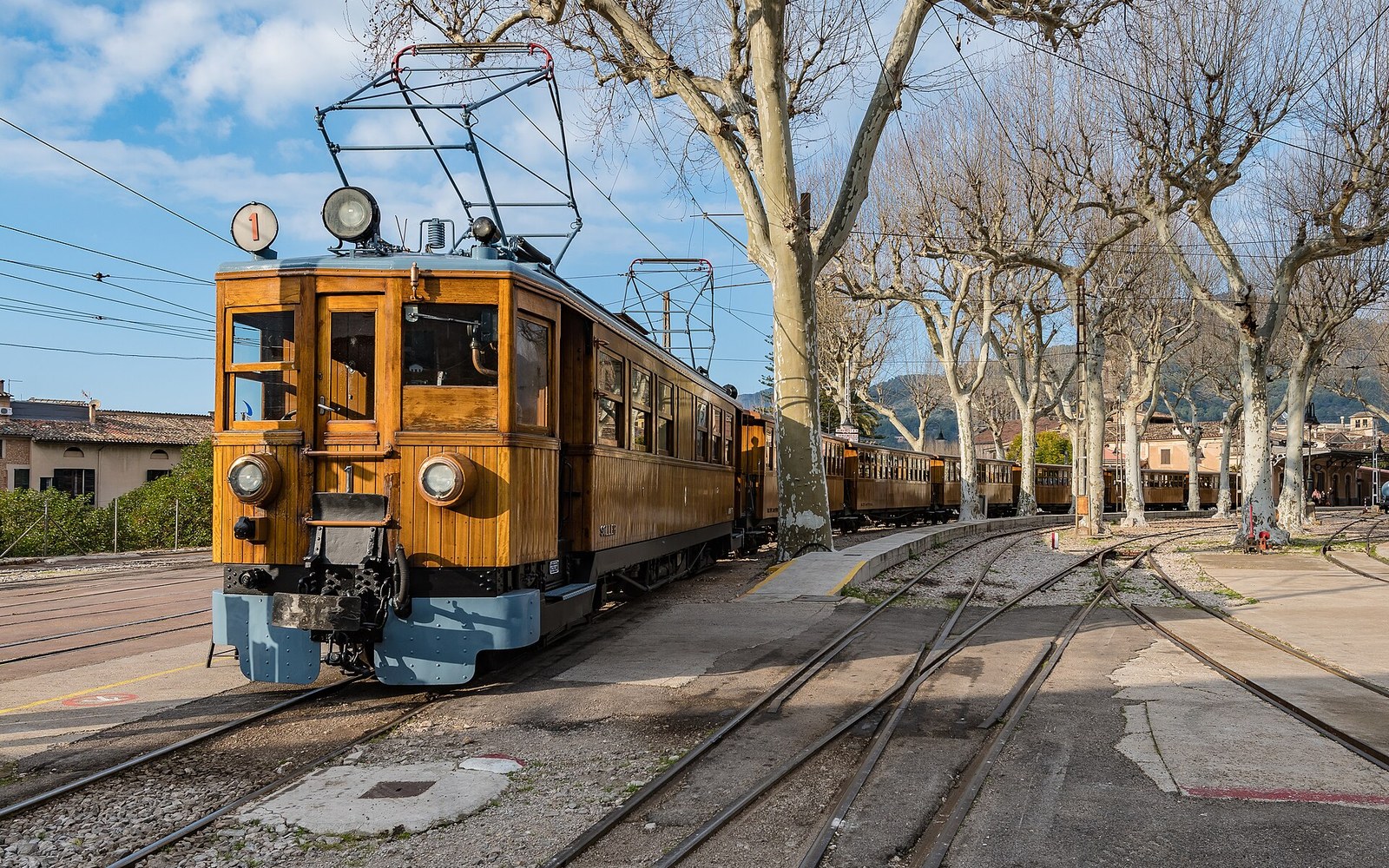
The railway between Palma and Sóller has been running since 1912, first with steam traction and, from 1929, with electricity. It survived the twentieth century intact for exactly the wrong reasons.
Why nobody bothered
The Sóller line was built to move oranges and workers across the Serra de Tramuntana, through a tunnel that was, at the time of its opening, the longest in Spain. Electric traction, which came later, suited the mountain gradients; the rolling stock, of polished mahogany and brass fittings, reflected the ambitions of the merchants who bankrolled it. The line connected Palma's Plaça d'Espanya to Sóller in just over an hour, and a secondary tramline continued down through the town to the port.
What kept the railway alive was not sentiment but arithmetic. Through the mid-twentieth century, the Spanish state invested in roads. Lines that could be replaced by a bus route were closed. The Sóller railway survived because replacing it required a road capable of handling the same traffic through genuinely difficult mountain terrain, and the cost was never quite justified. The tunnel, privately owned throughout, made the economics stranger still. The railway was too awkward to close, too slow to compete, and too specific in its geography to interest the planners who shuttered comparable lines across the peninsula.
Through the mid-twentieth century, the Spanish state invested in roads.
By the time road access to Sóller improved significantly — a new toll tunnel opened in 1997 — the railway had acquired a different kind of value. The wooden carriages that had simply never been replaced became, in themselves, the attraction. Tourists board at Palma not despite the hour-long journey but because of it: the curved viaducts, the orange groves of the Sóller valley, and the sense that the infrastructure has not been updated since your grandparents were young, because it largely hasn't.
The tramline from Sóller station to the port still runs original open-sided carriages ↗ built in the early twentieth century — some of them constructed from tram bodies acquired secondhand from Barcelona and San Francisco. The railway's full name is the Ferrocarril de Sóller, and it remains in private hands, as it always has been.
Key
- Mallorca
- Mediterranean
- This piece
- ●Sóller — the northern end of the wooden tram line
Survival through irrelevance is not a strategy anyone planned, but it has given Mallorca something the rationalised networks of the mainland cannot offer: a working railway that runs because nobody ever got around to killing it.