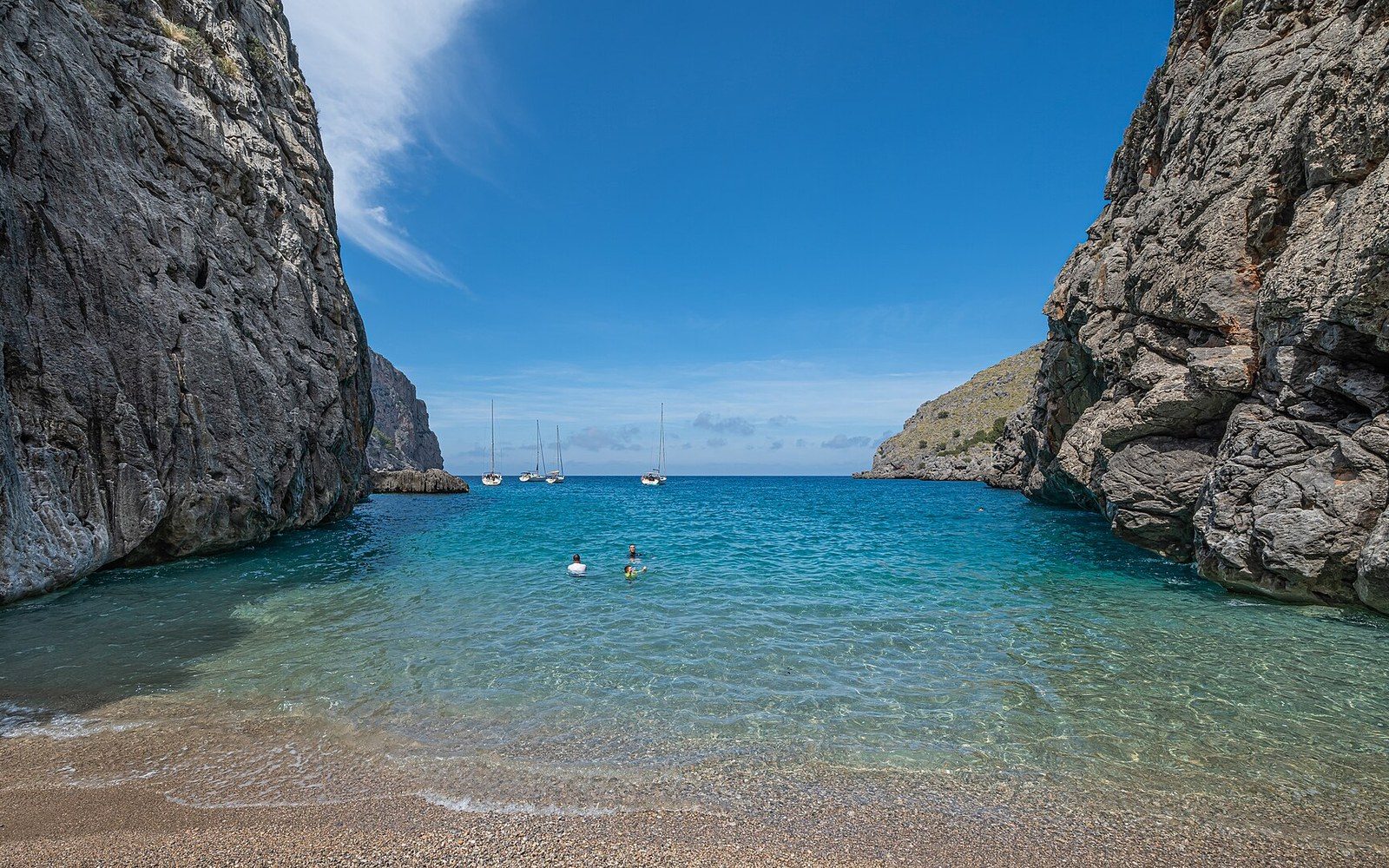
Mallorca's torrents look like roads and paths for most of the year. In hours, they can become something else entirely.
Stone channels, seasonal logic
A torrent — the Catalan word, close to the Spanish "torrente" — is not quite what English calls a river. It has a bed, banks and sometimes a name marked on maps going back centuries, but for eight or nine months of the year it holds no water at all. Walk across the Torrent de na Borges, which drains much of the plain behind Artà and Colònia de Sant Pere toward the Badia d'Alcúdia, and you cross pale gravel and sun-baked limestone, not a stream. Farmers have grazed animals in the beds. Paths run along them. In places, tracks cross them without a bridge because there has been no need for one within living memory.
The logic is Mediterranean and seasonal. The island's rainfall arrives in pulses — most of it in autumn and winter ↗, with summer months that can be almost entirely dry. When October or November rain does come, it often comes fast: convective storms rolling in from the east, dropping in hours what a northern European city might receive across a month. Limestone karst, which underlies most of the island's interior, absorbs a portion of that water into the aquifer below, but a sudden, heavy pulse overwhelms absorption and runs off hard into the channels the landscape has been carving for millennia.
Built across, then surprised
The problem is not ignorance — it is time. A torrent that floods once in thirty years begins to look permanent in its dryness. Roads cross it; structures encroach on its margins; the bed itself gets built over or compressed. Then the rains arrive and the channel, asked to carry what it was designed by geology to carry, is obstructed.
Then the rains arrive and the channel, asked to carry what it was designed by geology to carry, is obstructed.
This pattern is not unique to Artà, but the terrain around the town makes it locally vivid. The hilly interior behind the coast — the same limestone ridges that produced the Coves d'Artà and its cathedral-scale dissolution chambers — sheds water quickly when the ground is already saturated. The Llevant natural park, covering the cape and coast to the north-east, is cut by small seasonal drainages that are invisible in summer and suddenly active in wet years. Their catchments are short but steep, and water gains speed quickly over bare rock.
The torrents are also part of why this stretch of coast remained so undeveloped for so long. Infrastructure that crosses a seasonal watercourse cheaply tends to fail eventually. Serious bridges or culverts cost money that speculative coastal development in the mid-twentieth century was not always willing to spend on what looked like a dry ditch. The result, accidental as it was, helped preserve places like Cala Torta: a coastline that was simply awkward.
The aquifer underneath
What does not run off goes down. Mallorca's groundwater system depends substantially on this recharge — the torrents are not just a drainage problem but a replenishment mechanism. A fast, heavy rain that sends water surging down a torrent to the sea is, from the aquifer's perspective, wasted. Slow infiltration through permeable rock is what actually charges the island's underground reserves. Seasonal torrents in the Llevant, where the limestone is thick and relatively unbuilt, do allow some of that slower infiltration between flood pulses, which matters in a place where groundwater is under increasing extraction pressure.
Older Mallorcan engineering understood this balance instinctively. The dry-stone terraces that step the hillsides above the coastal plain — the same tradition recognised in the Serra de Tramuntana's UNESCO cultural landscape listing — were designed partly to slow runoff, hold soil and let water rest long enough to sink in. They did not stop floods, but they moderated the pulse. Where those terraces have been abandoned and the walls have collapsed, runoff is faster than it once was.
The torrent, then, is infrastructure in the most basic sense: a system the landscape built, that people have been variously ignoring, obstructing and, occasionally, working with for a very long time.