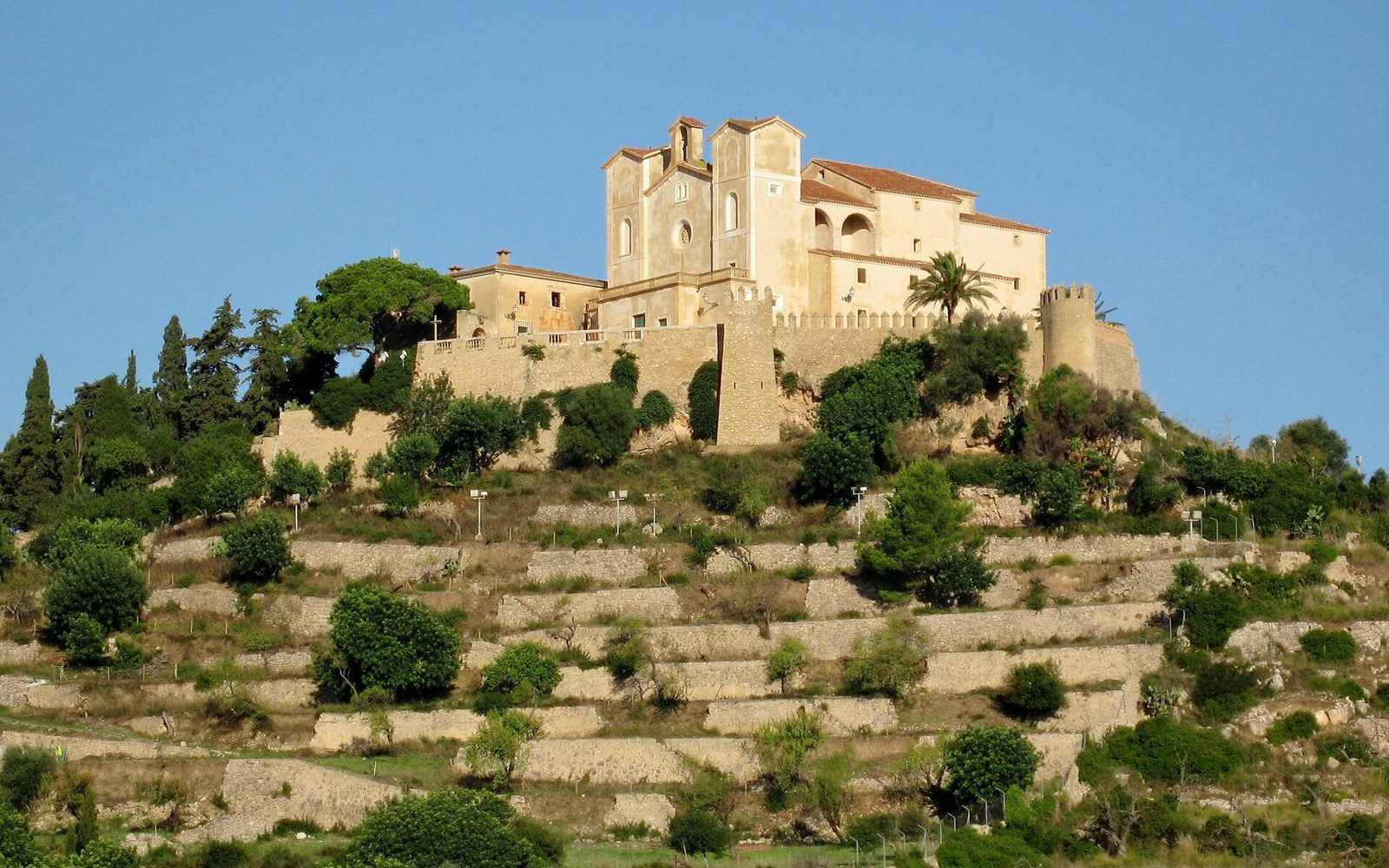
The hilltop above Artà has held a wall in every era of the island's history. The sanctuary of Sant Salvador is the latest thing to stand there, not the first.
The hill chooses its occupants
Puig de Sant Salvador rises directly above the town, which is not high by absolute measure but is decisive by local geography. It commands the plain of Artà in every direction: the bay of Alcúdia to the north-west, the rough limestone interior, and on clear days the far scarp of the Serra de Tramuntana across the island. Whoever held that crown controlled the sight lines, and the sight lines were the first form of security this part of Mallorca had.
The hill was fortified long before any church reached it. The talayotic culture — the Bronze Age people who raised the cyclopean stone settlements visible across the Llevant — understood elevated ground as a natural stronghold. While Ses Païsses down in the valley was their principal settlement, the ridge above it was almost certainly watched. The talayotic habit of choosing defensible ground is well documented across Mallorca, and Puig de Sant Salvador fits the pattern exactly: hard to approach, impossible to surprise.
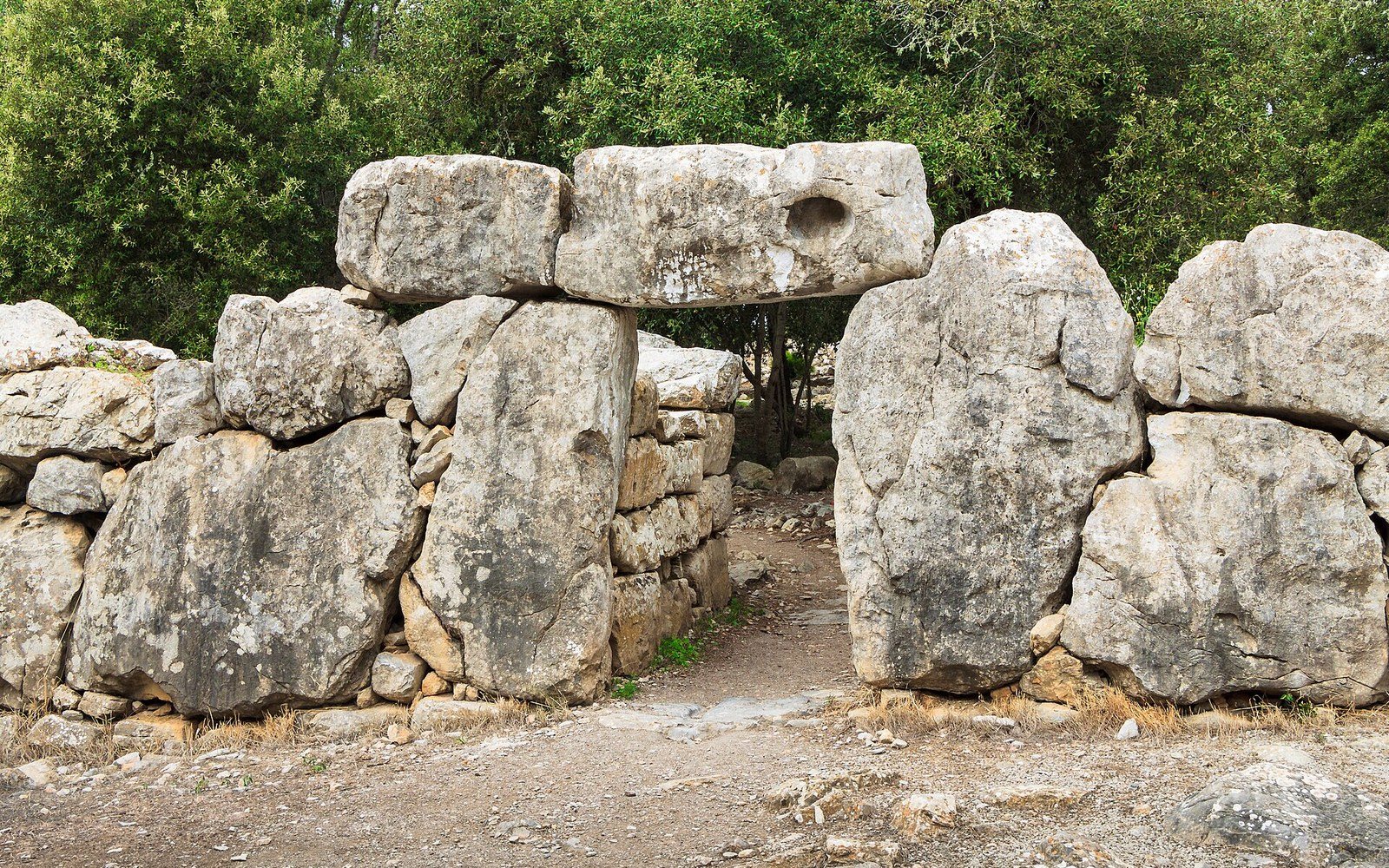
When the Moors held Mallorca before the Catalan conquest of 1229, the hill carried a fortified enclosure — a hisn, in Arabic, a castle-refuge that villagers could retreat into under threat. The Catalans who arrived with Jaume I absorbed the structure rather than levelling it. What you see today is in part the ghost of that earlier walled circuit, its outline preserved in the perimeter of the sanctuary precinct. Stones were reused, alignments were kept, and the logic of the place — a walled crown on defensible rock — remained constant across the change of regime.
What the Moors built and the Catholics kept
The Christian community that settled Artà after the conquest gradually transformed the military enclosure into a sacred one, but the transformation was never total. The sanctuary church of Sant Salvador stands inside a circuit of walls that retain their defensive profile: thick, high, angled at the corners to deflect rather than simply resist. The towers that punctuate the perimeter are not decorative. They are watchtower geometry, added to or maintained through the fourteenth and fifteenth centuries when the coast below was routinely threatened by North African corsairs. The tower network along the Llevant shore was the seaward line of that same defence; Sant Salvador was the inland redoubt.
The church itself has been rebuilt and enlarged over centuries, the present structure dating primarily from the eighteenth century, though the site's continuous religious use runs back to the medieval period. A Gothic figure of the Virgin — the Mare de Déu d'Artà — has been venerated here since at least the fourteenth century and remains the devotional centre of the sanctuary. Local people process to the hilltop on the feast days associated with her, as they have done for hundreds of years, and the path they take is not incidental to the experience: it is built into it.
The hill is steep enough that a road up the face would require extensive cutting and switchbacks; a stair wastes none of the gradient.
The stair as architecture and argument
The approach to Sant Salvador is a stair. Not a path that happens to have steps, but a formal monumental stairway — broad, stone-built, flanked at intervals by dry-stone retaining walls and by the cypresses that have come to define the ascent in photographs. The stair descends from the sanctuary gate in a nearly straight line to the edge of the old town below, and climbing it is the only proper way in. There is a road that reaches the precinct from the far side, used for deliveries and access, but the stair is the entrance the place declares.
This is architecture that encodes theology: the approach is effortful by design, the destination revealed only at the top, the body made to feel the ascent before the eye is given the view. It is also, less mystically, a response to the topography. The hill is steep enough that a road up the face would require extensive cutting and switchbacks; a stair wastes none of the gradient. Medieval builders in Mallorca understood how to read limestone, and they did not move more rock than they needed to.
The stair's current form dates largely from the early twentieth century, when restoration work reinforced and regularised what had become uneven and broken. The cypresses are of similar age, planted as part of the same effort to give the ascent its formal character. Older engravings and photographs show a scruffier approach, the steps present but uneven, the planting sparser — evidence that the grandeur is partly curated, without diminishing the genuine antiquity of the route itself.
What remains at the top
Inside the walled enclosure, the sanctuary complex is compact: the church, a small cloister-like courtyard, accommodation for the hermits who have kept the place since the nineteenth century, and the walls themselves. The walls are the real continuity. Walking the interior perimeter, you move along stonework that is medieval in origin, repaired in layers across six or seven centuries, and still entirely functional — they keep the wind off the courtyard in winter, and they define an interior world separate from the panorama just beyond them.
The hermit community — ermitans in Catalan — has maintained an unbroken presence on the hill since 1805, following a rule derived from the Carmelite tradition but specific to Mallorca's own hermitage culture ↗. Their role is partly liturgical and partly custodial: they maintain the church, tend the site, and receive the pilgrims and visitors who climb the stair. It is an arrangement that suits a place whose entire history is a form of tenure — each era holding the hill in its own way, for its own reasons, but holding it continuously.
What the talayotic builders ↗ understood, what the Moorish garrison understood, what the medieval Catalans who rebuilt the walls understood, is the same thing the hermits understand now: this particular piece of ground is not neutral. It sees too far, it stands too clearly, and once you have walled it, the walls become the argument for keeping them. Sant Salvador is a sanctuary because it was first a stronghold, and the stair is an entrance because the only honest approach to a fortified hill is one that makes you aware of the climb.